Last month, a client in Nigeria messaged me: "Vivian, I need a backhoe loader for my farm, but the big ones are too expensive and too wide for my roads. What do you suggest?"
My answer was simple: think mini.
Mini backhoe loaders are the fastest-growing segment in compact construction equipment. They're cheaper to buy, cheaper to ship, cheaper to run, and for a huge percentage of projects, they do everything you need. But buying one isn't just about picking the smallest machine on the list. There are real trade-offs, and I've seen buyers get it wrong.
Let me walk you through everything I tell my clients when they're considering a mini backhoe loader.
What Counts as a "Mini" Backhoe Loader?
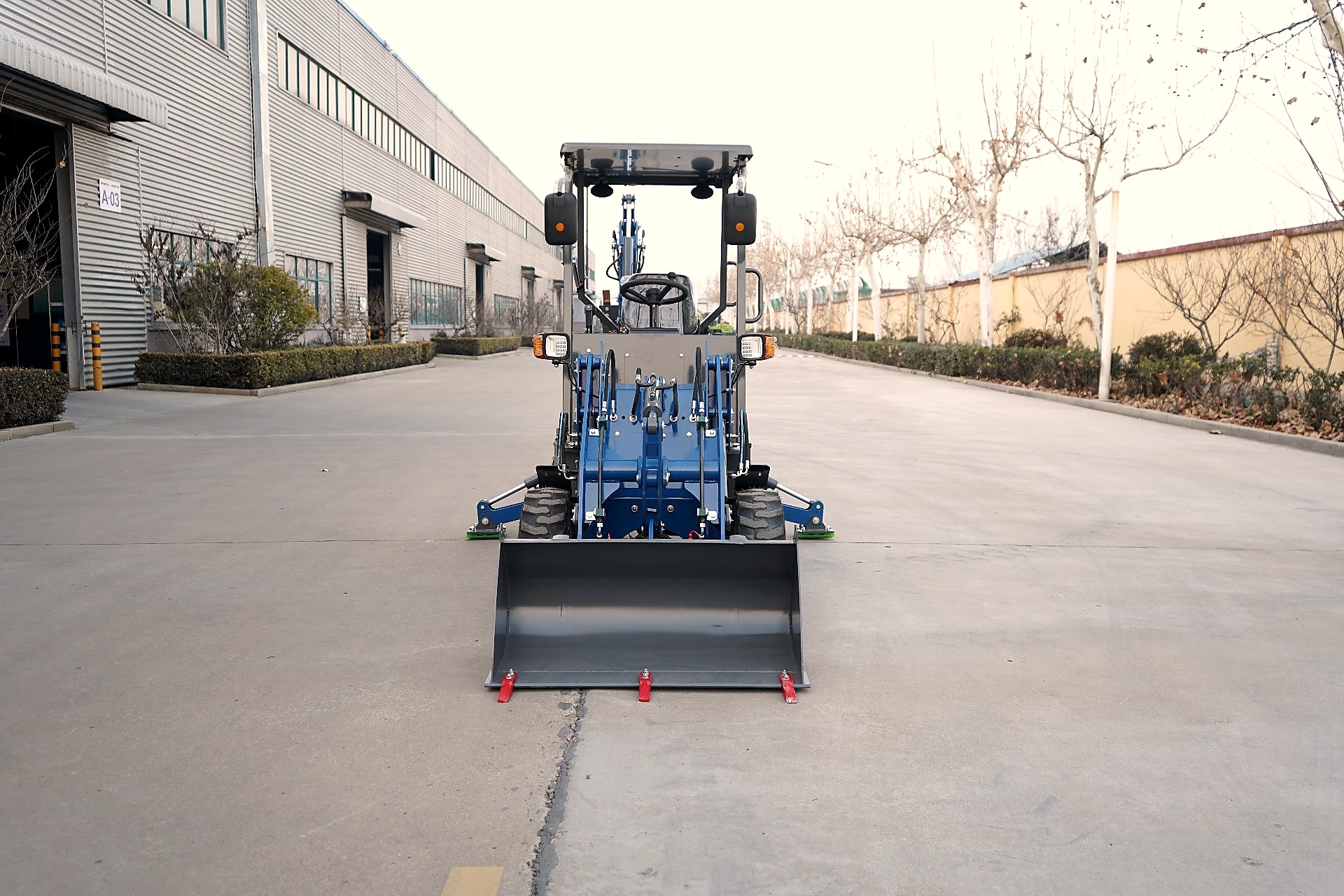
In my product line, mini backhoe loaders are machines under 2,500 kg operating weight with engines under 30 kW. They're designed for tight spaces, light construction, farm work, and landscaping.
Right now, I offer two mini models:
- BL 15-06 — Electric, 7.5 kW, 1,200 kg. The quietest option. No emissions. Ideal for indoor work, residential areas, and eco-sensitive sites. A diesel/internal combustion version is also available if your site needs more runtime flexibility.
- BL 20-07 — Diesel, 25 kW (CHANGCHAI 390), 2,350 kg. More power, standard dig depth of 1,850 mm. The workhorse mini for farms and small construction. Engine can be swapped to meet your country's emission standards if needed.
Electric vs Diesel: The First Decision
This is the question I get most often. Here's how I break it down:
| BL 15-06 (Electric) | BL 20-07 (Diesel) | |
|---|---|---|
| Power | 7.5 kW | 25 kW |
| Operating weight | 1,200 kg | 2,350 kg |
| Dig depth | 1,200 mm | 1,850 mm |
| Noise | Near silent | Standard diesel |
| Emissions | Zero | Tier 4 equivalent |
| Best for | Indoor, residential, eco sites | Farms, small construction, landscaping |
If you're working inside a building, next to a school, or on a site with emissions restrictions, the electric BL 15-06 is the obvious choice. For everything else, the diesel BL 20-07 gives you more power and deeper dig depth for not much more money.
Where Mini Backhoe Loaders Excel
I've shipped mini backhoe loaders to clients across Africa, Southeast Asia, and South America. Here's where they consistently outperform larger machines:
1. Farm and Agricultural Work
Digging irrigation channels, post holes for fencing, clearing drainage ditches, moving feed and soil. A mini backhoe loader handles 80% of farm earthmoving tasks at a fraction of the operating cost of a full-size machine.
2. Residential Construction
Foundation trenches for small houses, septic tank installation, landscaping, driveway preparation. The compact size means it fits through standard gates and works in residential neighborhoods without disturbing the street.
3. Municipal and Utility Work
Water line repair, cable trenching, sidewalk maintenance. Municipalities love mini backhoe loaders because one operator can transport it on a small trailer and handle the job solo.
4. Indoor and Eco-Sensitive Sites
The electric BL 15-06 has zero emissions and is nearly silent. I've had clients use it for indoor demolition, warehouse renovation, and work in nature reserves where diesel engines aren't allowed.
What a Mini Can't Do
I'm not going to pretend a mini backhoe loader can do everything. Here's where you'll need a bigger machine:
- Deep excavation: If you need to dig below 2 meters, the BL 20-07's 1,850 mm dig depth won't be enough. Look at the BL 45-18 or larger.
- Heavy material loading: Loading trucks with dense material (gravel, rock) at high volume requires a bigger bucket and more lifting capacity.
- Road construction: For continuous road building work, you'll want something in the 70-90 HP range like the BL 90-25.
My rule of thumb: If 70% of your work is light digging, loading, and material handling in tight spaces, a mini backhoe loader will pay for itself faster than any other machine.
Shipping Advantage
One thing buyers don't always think about: mini backhoe loaders are much cheaper to ship. The BL 15-06 fits in a standard container without disassembly. The BL 20-07 can be containerized with minimal preparation. Compare that to a 7-ton machine that requires a flat rack or special loading — you're saving $1,500-3,000 on freight alone.
For my clients in landlocked countries like Uganda, Mali, or Bolivia, this shipping savings can be the difference between making the purchase work or not.
The Bottom Line
Mini backhoe loaders aren't just small machines — they're purpose-built tools for specific jobs. If your work involves tight spaces, light construction, farm maintenance, or eco-sensitive sites, a mini will outperform a bigger machine while costing less to buy, ship, and operate.
The key is being honest about what you actually need. Tell me about your job site, and I'll tell you whether the electric BL 15-06, the diesel BL 20-07, or something bigger is the right fit.
Not sure if a mini backhoe loader is right for you?
Tell me about your project, your job site conditions, and what you'll be digging. I'll give you an honest recommendation — even if it means suggesting a different model.
Ask me on WhatsApp